
The highest-converting SaaS case studies follow a three-part structure—setup, complication, and resolution—that 93% of top-growing B2B companies use. This is not a marketing invention; it is the “challenge plot” identified by the Heath brothers in Made to Stick as one of the most reliably engaging story patterns. Applying it to customer proof turns a feature list into a narrative a buyer can see themselves in.
At its core, a compelling case study leverages storytelling centered around three pivotal elements: setup, complication, and resolution. This story arc is more than a B2B marketing tactic—it's a proven framework in storytelling.
In their book Made to Stick, the Heath brothers highlight the "challenge plot" as one of the most engaging ways to capture an audience's attention. By applying this structure, your case study will not only captivate but also position your solution as the hero of the story.
In this guide, we'll dive into each element of the case study, explain how to define its objectives and provide practical advice for formatting it to maximize impact.
Start with the Angle: Define Your Case Study Objective
A strong case study starts with a clear purpose. This is what we refer to as the "angle"—the central message or objective you want to communicate.
Ask yourself: What should this case study accomplish? Whether it's showcasing your solution's ability to automate a specific process or demonstrating ROI for a target industry, your angle sets the foundation for a compelling narrative.
To identify the angle, consult stakeholders within your organization. Speak with account executives, customer success managers, and consultants who've worked closely with the customer.
Their insights will help you uncover the customer's story and identify key themes such as "manual reporting inefficiencies" or "real-time data access issues."
Next, cross-reference these themes with your go-to-market strategy. Which pain points are your sales and marketing teams consistently addressing in discovery calls or proposals?
By capturing these themes in the customer's words, your case study will resonate more deeply with prospects while supporting your strategic goals.
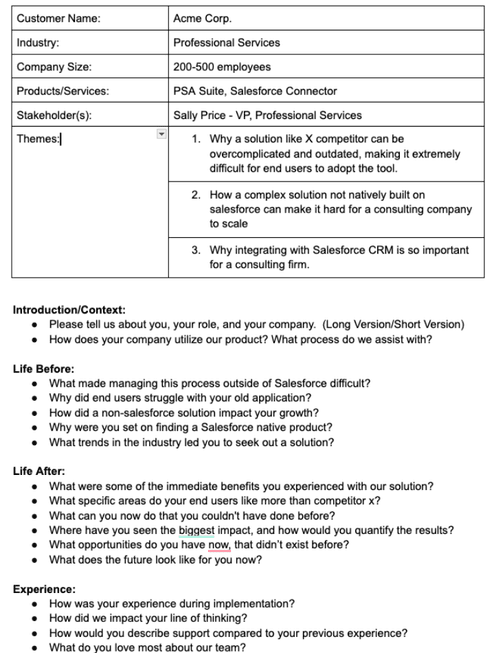
From this point forward, your case study objective and the underlying themes should be top of mind at every stage of the production process, especially for the actual interview itself. Here's a sample template for structuring your case study interviews.
Building a B2B Case Study: A Step-by-Step Guide
Once your angle is clear, the next step is to craft a compelling narrative. Let's assume you've conducted a great interview to gather all the necessary details (if you need tips, here's an article).
The structure of a strong SaaS case study flows naturally from the customer's challenge to the results they achieved with your solution.
1. Character Development: Setting the Stage
Every story needs a protagonist, and in a case study, your customer takes on this role. Start by introducing who they are and why their story matters.
Include concise details about their company, such as:
- Industry and Size: Is this a mid-sized healthcare company or a fast-growing fintech startup?
- Product Offering: What do they specialize in?
- Stakeholder's Role: What are their responsibilities and daily challenges?
For video case studies, brevity is critical. Use graphics or text overlays to convey these basics while allowing the subject to focus on their story.
This approach ensures your audience can quickly determine whether the story is relevant to them.
2. The Complication: Highlighting the Challenge
With the stage set, dive into the challenges your customer faced. This section builds tension, engaging your audience by making them eager to see how the problem will be solved.
Address the following key elements:
- The Problem: Clearly define the fundamental issue. For example: "Our CRM and website form weren't integrated, leading to inefficiencies."
- Previous Attempts: Highlight what alternatives the customer tried and why those solutions failed. This not only adds credibility but also helps prospects avoid wasting time evaluating suboptimal options.
- The Impact: Explain the negative outcomes caused by the problem. Differentiate between the root cause (the challenge) and its consequences (the impact). For instance:
- Problem: Disjointed CRM and website form.
- Impact:
- Sales reps took an average of 6 hours to respond to leads.
- Lead conversion rates were below the industry average of 20%.
Understanding the difference between problems and impacts is crucial. As a former VP of Sales, I often emphasized this during pipeline reviews.
A customer problem is the root cause—something hindering performance. For example, if a sales team isn't following up with leads promptly, the root cause could be poor training, lack of incentives, or inadequate tools.
We do everyone a disservice by stating that the problem in this case if we just state that the problem is "Sales team isn't following up with leads." No, that's the impact!
Dig deeper to understand the problem, and you can present better solutions. Case studies should drill into this distinction, summarizing both the underlying issue and its broader consequences.
Here's how you should have your customers frame this information in a cohesive challenge statement within your case studies:
"Due to a disjointed website and CRM, our salespeople were taking too long to follow up on leads, resulting in a conversion rate of less than 20%."
This concise statement frames the problem AND the impact in a way that positions your solution as the ideal fix.
3. The Resolution: Showcasing the Solution
Now it's time for the climax—the resolution. This is where your solution takes center stage, transforming the narrative into a story of success.
Focus on three key areas:
Solution Overview: Briefly describe how your offering solved the problem. Be sure to reference specific feature areas or any other distinction tied to your solution/service.
For example:
"Using Acme's PSA suite, Hooli was able to automate timecard approvals, reducing administrative overhead by 60%."
Results and Metrics: Quantify the impact. Percentages often resonate more than dollar figures, allowing prospects to map the results to their situations.
For example, instead of: "We saved $20,000 annually in IT software costs", say: "We reduced annual IT software costs by 20%." This way, an IT Director with a $100k annual and $1m software budget can relate.
Personal Benefits: Highlight the human side of success. Did your solution free up time for strategic initiatives or reduce stress for a key stakeholder?
These personal wins make the story relatable and engaging.
Formatting Your SaaS Case Study for Impact
The way you format your case study can significantly influence its effectiveness. A well-structured case study should:
- Quickly define the customer's challenges and the benefits of your solution.
- Present key details upfront for time-pressed decision-makers.
- Offer additional depth for audiences who prefer detailed narratives.
Audience Considerations
Different audiences consume content differently:
- Executives: They want results fast. Start with a summary of key impacts and metrics.
- Middle Management/Technical Staff: They value context and detail. Provide deeper insights in subsequent sections.
As Casey Hibbard explains in Stories That Sell, executives often need less information to make decisions and are less resistant to speaking with salespeople.
On the other hand, middle management or technical teams prefer detailed information to assess fit. Tailor your case study to meet these preferences.
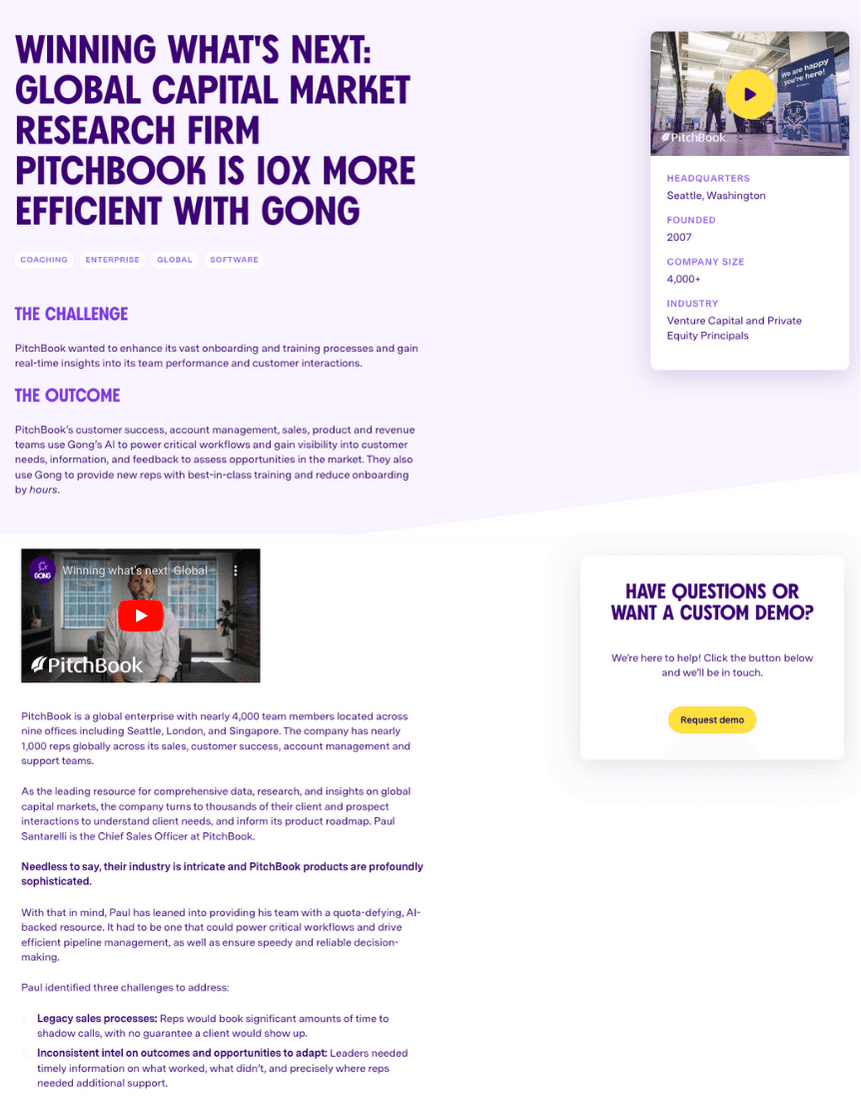
For video case studies, keep the runtime under 3 minutes, sticking to the story arc outlined here. For written case studies, begin with a "baseball card" of key facts, followed by a more detailed narrative.
Make sure to include a clear call-to-action—such as "Request a Demo"—near the middle of the piece to capture executive interest early that have already seen everything they need to see while allowing for more interested parties to continue scrolling down to learn more.
Keep that CTA close by no matter what because every reader may be "sold" on your story at different points on the page.
Gong.io does a great job with this and I highly recommend checking out some of their examples.
Final Thoughts - Why B2B Success Stories Matter
Writing an effective SaaS case study is more than documenting success—it's about creating a narrative that inspires action.
By defining a clear angle, presenting relatable challenges, and showcasing tangible results, you'll craft stories that engage, resonate, and convert.
When executed well, these stories become powerful tools for aligning sales and marketing, building trust, and driving conversations with new prospects.