
When planning questions for a case study, I liken it to preparing for a sales discovery call with a prospect. You're not trying to just run through a checklist of questions; you're facilitating a conversation to elicit thoughtful, genuine responses.
In a customer interview, you'll often guide clients to rephrase their answers or redo a take to ensure it resonates. This is why working with an outsourced interviewer often leads to a smoother experience. That is the model behind our done-for-you case study services: the interviews, drafting, and approvals are handled for you.
Choosing the Right Customers by Segment
Deciding on questions should begin well before the interview. It starts with selecting the right customers to feature in the case study.
Choose customers based on the segments you aim to highlight across customer stories to support your marketing and sales goals effectively.
For example, if you've segmented your customers and identified a high-value segment—say, mid-size U.S. manufacturing firms already on ServiceNow—you might want to focus on testimonials within this niche. By prepping questions within this theme, you can capture insights that resonate powerfully with similar prospects you're trying to close more of.
Consider the Content Assets You Want to Produce
To maximize the value of your interviews, plan your content needs upfront to shape your questions. If your goal is short video snippets, sales slides, or mid-funnel testimonials, aim to capture concise, impactful soundbites and core benefits rather than logistics.
For example, a buyer deciding whether to schedule a demo isn't likely to engage based on customer support praise. Instead, social proof at this stage should enhance your credibility regarding how your solution addresses specific problems.
Conversely, a prospect in the final stages of decision-making could benefit from a deeper understanding of your support team if competing products are similar. Tailoring questions with these needs in mind allows you to capture content that builds trust with prospects at every buyer journey stage.
Structuring Your Interview Template by Focus Areas and Themes
Create an interview template that documents the overarching themes so the interviewer remembers these priorities. Here's an example:
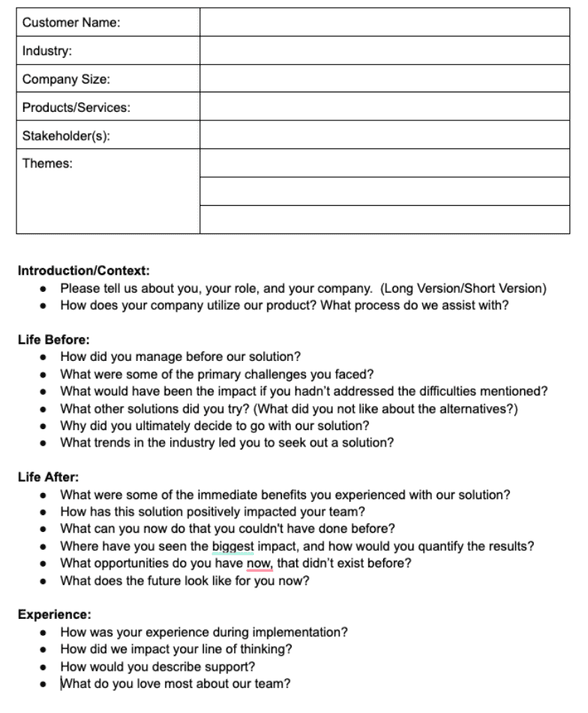
You'll note the overarching fields of segmentation, themes, and, of course, the generic questions you might expect. But let's now take this further for a more effective interview pre-read
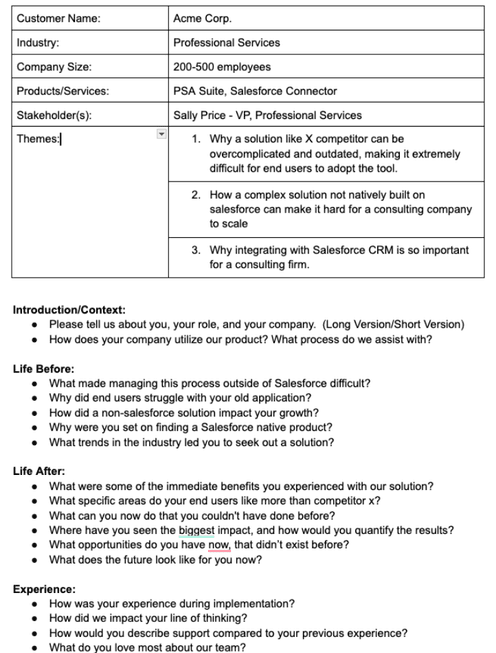
Let's assume we're a SaaS PSA company interviewing mid-market consultancies switching from a complex incumbent competitor to your user-friendly, Salesforce-native platform. If the customer selected for a testimonial matches this segment, thematic focus can help tailor questions for richer responses.
In this case, we've created a couple of primary themes we want to focus on during the call.
Themes:
- Why is a complex solution like X competitor overcomplicated, hindering end-user adoption?
- How non-native Salesforce solutions limit scalability for consulting firms.
- The critical role of Salesforce CRM integration for consulting firms.
With themes documented, you set the stage for an interview that captures responses aligned with your strategic goals. As you can see, we can now tailor the generic questions from the original template to be prepared to ask more thoughtful questions instead.
Less Is More: Prioritizing Your Questions by Importance
Order your questions by importance and avoid saving key questions for the end of the interview. You may have noticed in the interview template above that we've listed the "life after" questions before the "experience" questions.
This is to prioritize impactful before-and-after stories that influence early-stage prospects. While experience-based stories are helpful, other social proof assets, like customer reviews, often cover these areas so we don't need to prioritize them as much in these conversations.
Also, keep in mind the limited time you have. When a customer's response hits a valuable point, you will want to dig deeper.
Ask follow-up questions, refine their answers, or request short and long-form versions of key insights. These nuanced responses can be repurposed across multiple content types, from social ads to website testimonials.
The point is, if the customer is giving you gold, don't rush through to get to less impactful questions in your interview sheet.
Conclusion
It's important to tailor the specific questions you ask per the themes and objectives you define beforehand. Interviewing a customer is part art, part strategy.
You're guiding them to share quantifiable insights, ensuring their responses fit various content formats, and focusing on the responses that will resonate most. If you don't have the time or expertise available in-house, then outsourcing these projects may make a lot of sense.
Thoughtful questions are just the beginning, but they set the stage for capturing insights that truly make an impact.
To capture and act on those insights at scale, see our 2026 voice of the customer software comparison.
