
When you speak with customers, you create opportunities to produce valuable insight that your prospects will value because, frankly, it's not your sales team making the claims. In fact, only 29% of buyers fully trust Salespeople from vendors.
It's no surprise that case studies are one of the primary ways to resolve this predicament.
The Challenge With Getting Case Studies
Acquiring case studies can often create an awkward predicament for GTM teams, particularly smaller companies, because they're not formally assigned to any individual. They require a multitude of skills that one person typically doesn't collectively have, and the task doesn't occur often enough to have any efficient processes around them.
So, though case studies can be your most valuable marketing asset, they often get pushed aside. When they are finally delivered, they aren't maximized across your organization.
This is a wasted opportunity because a single customer interview can be repurposed in so many ways, delivering value at different stages of the buyer journey — and even beyond it, since the same on-record proof is how smaller SaaS vendors break into platform partner ecosystems. Let's break it down.
Let's say you conduct a 45-minute recorded interview with one of your esteemed customers. If you did a good job, then you should have captured valuable insights on items such as:
- What challenges were they facing before finding your solution?
- When did they know they needed to make a change?
- What other solutions did they try or evaluate, and what went wrong?
- Did they have any concerns going into your partnership, and how did you overcome them?
- What benefits did they receive from your solution?
- What new opportunities do they have now that they didn't have prior?
- What is it like working with your team?
Quality answers to the questions above are a gold mine of value to your business. But too many companies try to consolidate the answers to a handful of questions like this into one case study video, packing in as much as they can.
This creates a video that is too long and not 100% relevant to the stage a buyer might be in.
Mapping your Case Studies to the Buyer Funnel
First, you need to go into the interview with a plan around all the potential assets you hope to produce so you can structure your questions accordingly. This is an art form that takes time to excel at but is very important.
Then, it's about mapping the touch points across the buyer journey with your brand and how you can break down the interview to maximize the quality of the engagement at each individual touch point. In marketing, this is called a content funnel.
Terms may vary, but generally, you find something like this.
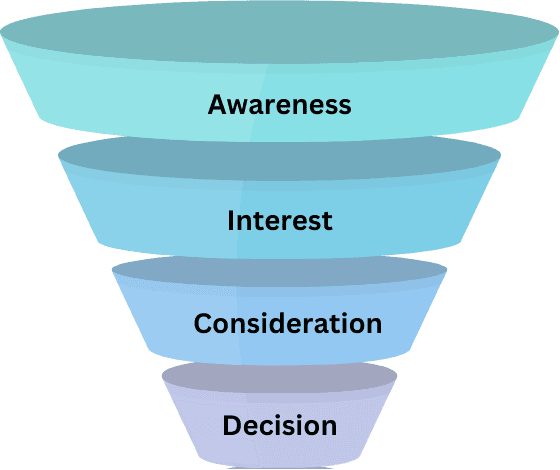
It's important to consider the buyer funnel because during these stages a prospect has different requirements. If you just leverage a long form case study for every stage, you diminish the value of the case study as a whole.
For example:
Awareness Stage: A target audience that is unaware of your product could care less about what it is like working with your stellar support staff when they have yet to admit they need a solution to their problem.
Interest: A target audience in the interest stage has yet to be ready to rule out other potential vendors or solutions.
Consideration Stage: An educated, qualified prospect by the sales team doesn't need to revisit content surrounding the challenges of not having a solution.
As we've already made clear, the advantage of a customer interview is that its contents can be extended across the entire funnel. Let's break down how.
Create Awareness with Video Snippets, Quote Cards, and Blogs
Video Snippets & Quote Cards,
When it comes to driving awareness to your target audience, you have paid and organic methods. On the paid side, you're dealing with short attention spans that call for short, snappy content.
Quote cards or videos no more than 30 seconds can engage your audience if you have the appropriate hook. Often, at this stage, that means a message that resonates with their current situation.
Believe it or not, something like, "Spreadsheets we're no longer scalable for us to onboard customers…" Goes a lot further than, "We saved $180k annually on onboarding expenses."
Why? At this stage, the prospect isn't even fully aware of their problem and the urgency to solve it. The savings in cost is certainly a benefit that will move the needle forward later on, but at this stage, it comes off as "sales" and "scammy" because they have yet to develop trust with your brand.
Guest Blogs and Expert Quotes
On the organic side of awareness, you may also pull some pieces of the interview to provide credibility to a blog post surrounding a specific keyword you're targeting. Or you could post the customer story as a blog post.
Customer stories may not generate as much direct traffic in themselves, but you can interlink them across other blog posts. You have that wider reach and start to funnel traffic for targeted audiences that find value in your content and continue building social proof with them.
Create Interest with Long Form Case Studies, 1 Pagers, & Landing Pages
Long Form Case Studies
As prospects in your target audience send signals to you, whether that be a video watch, a click for retargeting, or an open email and a link click from an outbound email, you can start to assume that they might be more inclined to invest more time in what you present to them.
These are additional opportunities to build credibility and trust and ultimately try to convert them into opportunities.
Long-form case studies can be a great way to generate inbound leads to prospects further. They are incredible signals to your marketing department because they've taken action to learn more about a customer success story that resonates with them.
This is a hot lead, assuming you want more customers who are like your best customers.
One Pagers
One-pagers are great for prospecting. A golden rule with sales reps is to always reach out to a prospect who offers something of value.
A well-designed one-pager helps warm up cold calls and emails, making them more relatable and less sales-y. It also provides great talking points to BDRs on the phone with prospects, allowing them to quickly follow up and back up their claims.
(This is necessary when a 23-year-old tells a VP how we can address x problem).
Landing Pages
Lastly, at this buyer journey stage, your prospect will likely visit your website. If they aren't being actively served up a specific case study across other marketing channels they may be less likely to fully dive into one on your broader case study catalog, but credibility in this case is built in having the appropriate volume of case studies.
As they scan your page and see notable peers, this builds more confidence in your brand. If you serve different markets and use cases, make is easy for them to toggle them on to be served the most relevant content with subject lines that truly address what they're looking to solve.
Get to a Decision with Sales Slides, Video Answers, & Enablement
Sales Slides
The evaluation process for the first demo typically involves a new audience, so you have to rebuild credibility and trust with more stakeholders. Having your customer testimonial repurposed for these formats, particularly demo slides, is very important to get everyone else caught up.
This is very important when it comes to expediting the sales process. Think about trust.
When you have an employee you fully trust and they have a task that you need them to complete, you're less interested in how they intend to complete it. You trust that they will figure it out.
The same goes for sales cycles. Without trust, evaluations can become incredibly technical and overly scrutinized.
Particularly in industries like SaaS, there's no one size fits all, but your customer base represents what can be accomplished if they do things your way. That means adopting new processes, adhering to certain best practices, and trusting your team to make any necessary adjustments and alleviate problems that arise throughout the process.
We recommend arming sales reps with as much collateral as they can to navigate the arduous sales process. Every demo is a chance to showcase a similar custom that solved a similar problem.
Every question or concern is an opportunity to provide an answer with a relevant one-pager or video testimonial that a customer references the same concern.
If you can show your prospects that you HAVE done something before, they will be less inclined to check underneath every stone for HOW you do it. It's safe to say that this can expedite the sales process drastically.
Short-Form Video Content That Answers Common Questions
How many times have you had a prospect ask for a live reference call before they've even selected you as a preferred vendor? For larger companies with established reference programs and incentives, this may not be as much of an issue, but for many small and mid-market SaaS companies, it is simply not scalable and can be a huge waste of your clients' time.
As a rule of thumb, you should only offer a reference call once all other boxes have been checked within the evaluation criteria for the prospect. Most prospects should understand why this is the case.
The last thing you want is to burden a key client with a reference call only to find that the prospect has a must-have technical requirement you can't meet.
Quality case studies, particularly video recordings, can satisfy these requests, at the very least for the time being, to fend off any live references. When you have relevant case studies for your sales team, they can still offer something valuable to the prospect rather than simply saying no or caving to a premature request.
During customer interviews, you often get gems of information that answer common questions or concerns. If the area they cover comes up frequently enough in the sales cycle, you may decide to either make sure you include these in long-form case studies or have additional video snippets at the ready for quick sendouts.
Yes, these are small moments peppered throughout a typical sales cycle, but now you can turn them into memorable social proofing moments with relevant content to back up any claims.
Hey Leslie, Yes, you can integrate our solution with Netsuite! We have an out-of-the-box integration that you can install at no additional cost. I'm actually glad you asked! John from Acme Corp touches on this in their case study. Consolidating their systems has been a lifesaver for them and they've actually reduced their administrative cost by 25%. Let me know if you have any other questions! Regards, Sally
Training Material for Your Team
Your customer interviews aren't just for prospects—they're also a goldmine for internal training. Sales and marketing teams can learn a lot by hearing how customers describe your product in their own words.
You can even learn things you didn't expect. Customers may be getting value out of the product in ways that sales never intended, and these are vital selling points that you can incorporate into your value proposition.
In the early days of any startup, sales reps may naturally be knowledgeable about the actual customer experience. But as your organization grows, especially in this remote economy, new hires can greatly benefit from documented case studies.
If you're targeting prospects the right way, there's no reason why a new hire can't reference key selling points from case studies in their talk track from cold calls, discoveries, and demos. Plus it's always comforting to know you're selling something that's already made a difference for someone else.
In Conclusion
Customer testimonials and case studies are invaluable assets that can provide immense value across various stages of the buyer journey. A single customer interview has the potential to generate a wealth of content that can be strategically repurposed to build trust, establish credibility, and accelerate the sales process. That repurposing is simplest when the interview and its approved quotes live in a system of record for customer proof.
By thoughtfully preparing for customer interviews and leveraging the insights they reveal, companies can enhance their marketing and sales efforts, ensuring they make the most of every customer interaction.
Testimonials not only resonate with prospects but also serve as powerful tools for internal training and scaling customer success stories, ultimately driving growth and brand loyalty.
Ready to turn those interviews into a managed program? Our 2026 customer advocacy software comparison scores the platforms that do it.
