
Getting approvals on customer testimonials isn't always straightforward. First, you need to get a business stakeholder to agree.
Then, suppose it's a larger enterprise or a sensitive industry. In that case, you and the business stakeholder will be at the mercy of their internal approver, who may include their legal or marketing department, for what you can share.
An art form is required to ensure that you get the best customer testimonial and as many content assets as possible and that all of them get approved for mass consumption.
Here's the thing. There's no silver bullet for getting content approved by marketing or legal.
However, I would challenge you not to think of these approvals as prerequisites before having the recorded interview. (Particularly lower-cost remote interviews)
Getting Case Studies is a Sales Process
In many ways, it's similar to a sales process. In a deal cycle, you know a final approver on the executive team could green-light the entire thing.
However, you're currently working with a champion(interviewee) who is most intimately involved with your product.
Would it be ideal to go straight to the final approver and get the "OK" before you begin the work? Of course. But we know that it's not that simple.
In any evaluation process, there's a certain amount of legwork to be done so we know how to present the information to the final executive in the best possible way for the highest chance of approval.
Without doing this, you get rejected too quickly without a genuine opportunity to highlight your value. The same goes for a case study.
Why seek approval on something you can't even fully detail out yet?
Find Customers That are Most Likely to Approve
Obviously criteria one is going after happy customers. However, following that, here are some other factors to consider if you want to target customers that will give you the highest likelihood of mass approval.
Review Customer Contracts: Check if your customer agreements include a trademark licensing clause. This can significantly impact the likelihood of approval for a case study.
Ask your legal department or review their terms yourself, and control-f "trademark clause," "Licensing," and "Use of Logo" to find out.
If you want to be even more proactive, consider keeping track of this information in your CRM with a simple picklist that you update for every newly signed customer. It can streamline the selection process when identifying suitable customers for testimonials in the future.
Research Existing Case Studies: Investigate whether the customer has previously participated in case studies with other companies.
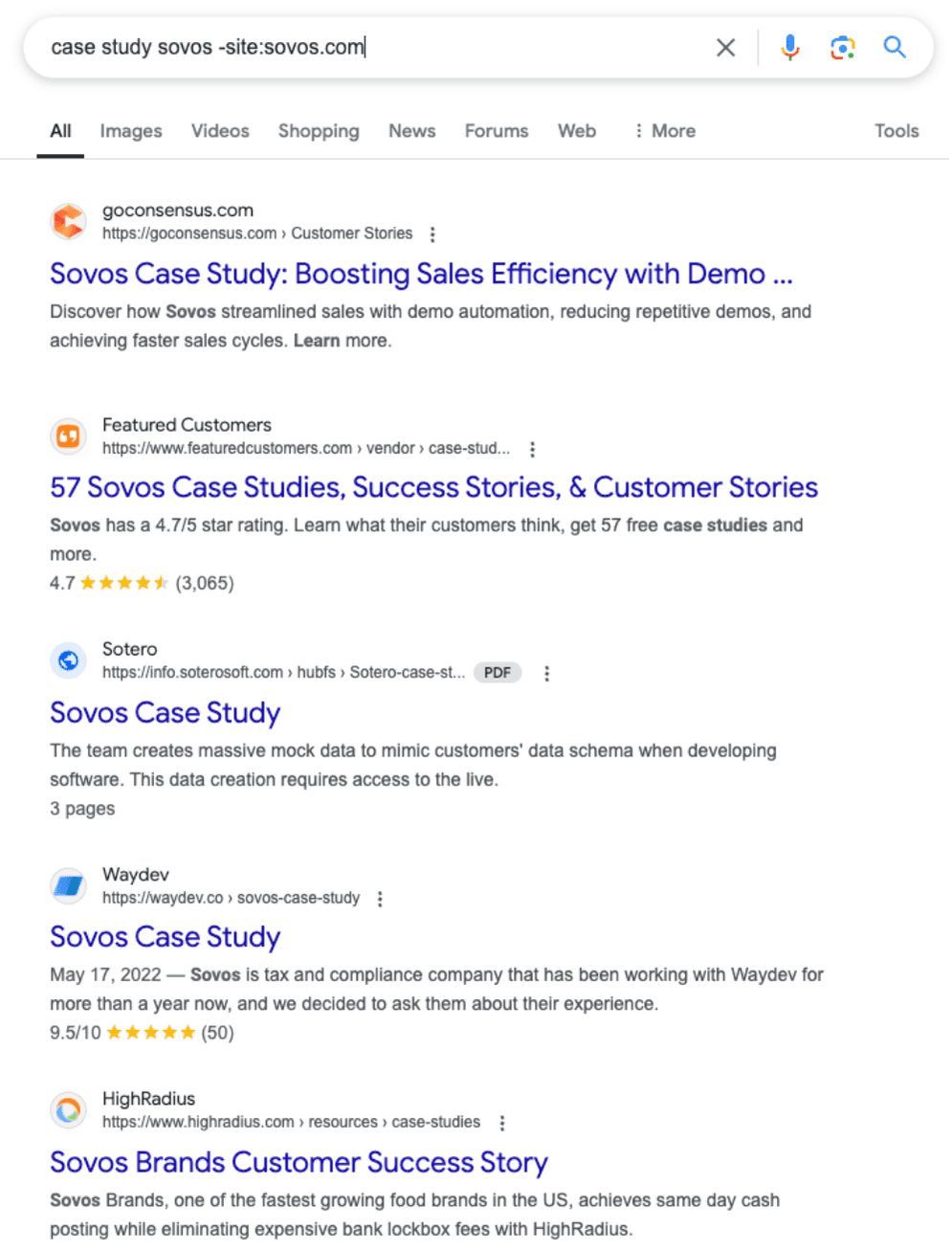
Using Google's Advanced Search, search terms like "case study (company name)" or "success story (company name)" while excluding the customer's website can help you identify any past case studies, indicating their openness to marketing collaborations.
Here's how you do it. Let's assume we're trying to get a case study from Sovos.
Type "Case Study Sovos -site:sovos.com" into your Google search. What's important here is the hyphen(-) in front of the "site:company.com". This is what will exclude that domain from the search.
As you can see, they have approved a long list of case studies for other companies. You can also look through them to understand how much detail they're willing to share with their partners.
When the Opportunity Comes
Our recommendation is this: If you have a customer stakeholder willing to do an interview. Take it.
If they can inform you how much can be approved for mass consumption upon the initial request...great. If they're unsure, inform them that you can be flexible around what gets published and that you value their testimonial no matter the final say that legal or marketing may enforce.
Remember. Your case study is not a top priority for their legal department, and if you delay the interview, you risk not striking while the iron is hot with your customer stakeholder.
You also want your interviewee to be an open book and share the intimate details you want. So it's best not to taint that with warnings from legal at this stage.
At Proofmap, when we run case study interviews for clients and we're unsure of what will be available for approval, we get a couple of different answers to the same questions to account for the level of detail that can be shared later on.
With a multi-faceted approach to customer testimonials, you can scale down specific details the customers share in some channels while using their entire message in others.
The Types of Case Study Approvals
At the end of the day, you will be presented with one of these scenarios from a permissions perspective.
- Full Approval: The client grants permission to use their company name, logo, and the contact's identity. You are free to distribute and showcase the case study in any manner you choose.
- Guided Approval: The client allows the use of their company name, logo, and the contact's identity, but with specific guidelines or limitations on how the case study can be shared.
- Selective Approval: The client prefers not to have their company name and logo publicly used. However, they agree to provide the case study, allowing it to be shared in select situations or with their approval prior.
- Anonymous Participation: The client does not permit the inclusion of their name or logo in the case study. However, they are open to participating, and you may describe their organization in the case study as anonymous.
We're all shooting for Full Approval, but let's examine the least preferred option.
The "Worst Case Scenario"
So, let's say you have a customer stakeholder that agrees to a customer interview. You decide not to go through their internal approval process before the interview.
You capture a wealth of information surrounding how they receive value from your product, some anecdotes about the challenges they faced prior, and the opportunities they uncovered now that they're free of those challenges.
It's a fantastic conversation; you have it all recorded, and prospects will eat it up! Then, the legal team rejects the testimonial request.
You can't associate their company logos or the stakeholder's identity with any content you create. What are you left with?
Frankly, quite a lot.
Anonymous Written Case Studies
Most often, you can still create a case study that shares the technographic information of the customer but keeps their identity anonymous.
This isn't particularly valuable on your website. However, for written case studies that sales reps can share with prospects, it's still very valuable to present similar circumstances and success stories to garner more trust.
Assuming that you share relevant case studies with prospects, they should understand the anonymous context because they likely operate in the same industry and a company with similar restrictions. They may even appreciate it.
Now, for this example, let's reaffirm our initial recommendation. No matter what, your testimonial request would have been rejected for mass consumption anyway.
However, by giving the stakeholders an environment where that's not a certainty, they're more inclined to reveal more valuable insight with metrics to back it up.
Not to mention, because their identity at this stage is still expected to be tied to the case study and viewed by a broad audience, their participation will be more engaging.
Sales Enablement
At my first startup as an Account Executive, my sales conversations changed dramatically after I had a couple of years under my belt.
It wasn't just because I developed my sales tactics and familiarized myself with the product and industry. I worked at a small company with around 20 employees and was primarily in the office.
After I signed a client, my girlfriend(now wife) was on the implementation team that onboarded the client. Some of my best friends were on the customer success team that maintained the client a couple of months later. True story.
It was a unique situation in which I was very informed about the customer experience, which benefited me in several ways.
For starters, I had anecdotes about specific use cases and solutions we developed for customers and how they benefited from them. These weren't scripted value propositions but genuine moments of recollections I could share with prospects.
Even without the actual content and the customer logos, the customer's voice was present in how I sold—every day.
Secondly, the actual solutions to the problems I was trying to help prospects solve weren't always as I or even the product team expected to solve them.
By staying close to customer stories even after I had handed over the baton, I could see how solutions actually became reality and work these into my sales narrative, providing substantive responses to prospects that went beyond product features.
Scaling a Sales Team
Fast-forward a couple of years, and I'm the Head of Sales trying to grow a team. I wonder how I can emulate those same tactics to a new generation of AEs without the close relationships I had at a 20-person startup and, of course, without the years of experience.
The answer was customer interviews.
A customer interview can still be included in your go-to-market narrative without a single marketing content. These raw recordings were often our most valuable internal assets.
We could incorporate these stories into our ICP and Persona decks. We even cataloged them in our CRM, so new hires could easily reference them repeatedly when coming across challenge statements that had been referenced before.
Develop a Relationship
There's this notion that you can only have one favor per customer stakeholder. In my experience, this just wasn't the case.
If you play your cards right, a customer who provides one favor is likelier to do it again. Doing something nice for another is often the beginning of any friendship, and it's fair to say that, ideally, they continue and grow.
In any relationship, there should be mutual benefit, and you should continue to invest in any stakeholder who agrees to praise you.
There are various ways to do this, such as offering free tickets to your conference, a discount on a single service engagement, or insight and input on the product roadmap. Whatever it is, invest in it.
A couple of months later, a top prospect will be on the cusp of closing but insist on a live customer reference before doing so.
A customer who has already provided you with a recorded interview is a customer you know is happy, and better yet, you already know precisely what they will say about your product or service.
Now, you shouldn't abuse this with any particular client, so you should get as many testimonials as possible.
But I can confidently state that in the last couple of years at my first startup, we never put a customer on an important reference call who hadn't done a testimonial for us already.
I recommend considering your testimonials as a catalog of referenceable customers for sales prospects. When you look at it this way, acquiring as many as possible makes sense.
In Conclusion
In conclusion, navigating the landscape of customer testimonials requires a strategic blend of art and practicality.
While achieving the ideal testimonial may seem daunting, focusing on securing valuable insights from willing stakeholders is the most crucial part, and you shouldn't delay that opportunity when presented with it.
Even if full permissions aren't granted, the wealth of information gathered can be leveraged creatively, such as anonymous case studies or internal sales narratives.
Remember, the goal is to foster relationships and maintain a catalog of satisfied customers who can vouch for your product.
By valuing each interaction and continuously investing in these relationships, you create a robust foundation for future success. The point is, don't let great deter you from still going after something really, really good.
Have as many customer interviews as you possibly can.
