
There's no debate that social proof moves prospects closer to being customers, whether it's a social ad, a blog post, sales collateral, or even a live reference call in the latter stages of an evaluation.
Keeping this in mind, plotting out all the content you will need across your entire customer journey is essential. One area that should get considerable attention is sharing customer stories on your website.
Chances are, this is where you get the most eyes on your brand, and installing credibility and trust should be a top priority for any visitor, especially prospects. If you're evaluating tools to power this, our 2026 customer testimonial & social proof software report compares the leading platforms.
We could have compiled a list of several companies doing this well to help you spark ideas for your website, but plenty of articles are already doing that. Instead, let's look at one company that is doing this exceedingly well and truly break down everything they are doing from a customer story perspective on their website for you to emulate.
The company in review: Gong.io
Who is Gong.io?
Gong.io is a software company specializing in revenue intelligence, offering a platform that helps sales teams analyze their customer interactions. Since its founding in 2015, Gong has experienced significant growth, raising substantial funding and expanding its customer base to include numerous Fortune 500 companies.
In 2023, Gong was named one of the world's top 100 privately held cloud software companies. With 4000+ customers, testimonials and success stories have been essential to their content marketing strategy.
Let's break down how they utilize social proof from the moment you land on their homepage and investigate some of their tactics as you make your way deeper into their site.
What is Social Proof?
Social proof is a psychological principle indicating that individuals are more inclined to adopt certain behaviors, buy specific products, or follow trends when they see others doing so.
When people notice that others are engaging in a behavior or purchasing a product, it enhances the perceived credibility and value of that choice.
Social proof is leveraged in marketing to establish trust and credibility, fostering confidence among potential buyers. Demonstrating that others, similar to them, have had positive experiences with your offerings creates a sense of reassurance that can encourage them to make a purchase.
In the B2B space, the critical aspect to this equation is social proof amongst industry peers. When it comes to achieving mass market success, studies have shown that social proof may be just as necessary as your technology or solution.
Geofree Moore's widespread book, Crossing the Chasm, covers this concept in depth. The idea is that the majority of the marketplace isn't as risk-tolerant as innovators and early adopters, and to "cross the chasm" and capture the majority market, you need to prove that your solution is trusted and accepted.
"The key to this shift in focus is moving from a technology orientation to a people/human orientation." At a higher level, what this means is that you need to be fully invested in customer stories.
The Homepage
Immediately, within the "hero section" of the homepage, you're met with two straightforward social proof tactics.
- "Some of our 4000+ customers." This signals trust across a broad marketplace, opening the possibility for many different types of companies to keep Gong.io in consideration. The Header text is also not limiting in any way. "The AI platform that transforms your revenue growth" applies to many business types.
- The six logos listed on the homepage are also pretty straightforward. These are their most recognizable brands.
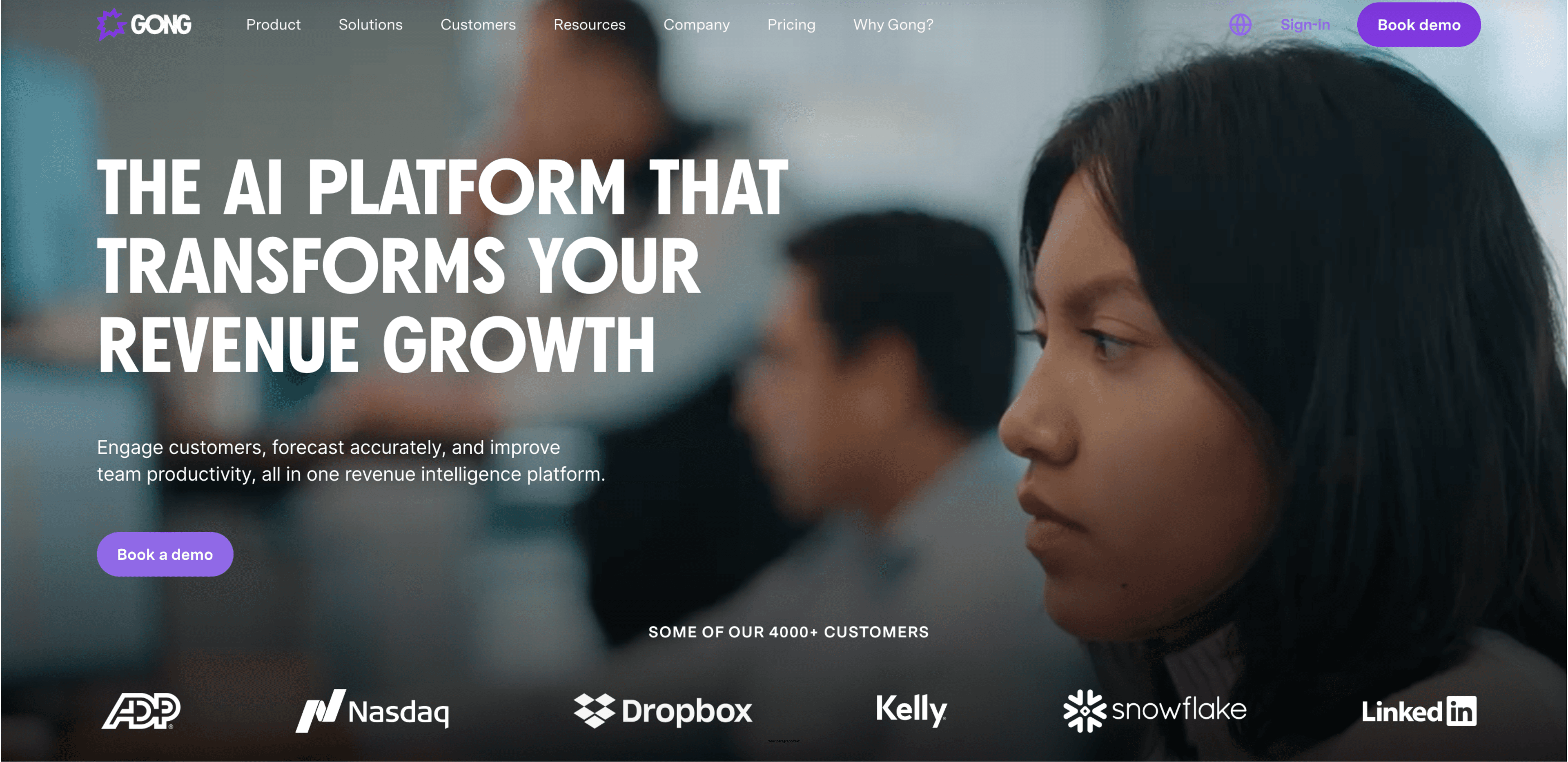
Key Takeaway: Leverage your most recognizable brands across your first frame to establish credibility.
When mapping what companies' logos and types of social proof to place across your content cycle, it's important to think about the goal for that micro-moment of that buyer journey.
The hero section is primarily meant to simply keep the visitor on the page. This is accomplished with a compelling headline that doesn't box anybody out, a very visual video playing in the background, and, most importantly, a stamp of approval across 4000+ companies and some of the most notable brands in the world.
It's worth noting that in this micro-moment, the purpose of social proof isn't necessarily to develop trust but more to build credibility. Even if I'm in a completely different industry from Amazon, I'm likely well aware of the extensive evaluation process and the required financial stability of a company to land Amazon as a client.
There's credibility obtained in that, but I do not necessarily trust that they can accomplish what I need. Yet. For that, let's continue along.
The next section of the homepage is fascinating because what Gong.io does really well here is work in social proof in a section that typically is utilized by SaaS companies to describe what their product does.

I love this tactic because we all chase outcomes rather than product features. In addition, we're used to seeing a product feature section with a general hyperbolic claim like "10x benefit with x feature," followed by a couple of additional sub-bullets below and a fancy infographic.
Gong.io does one thing to bring more credibility to a similar claim, and it works very well. They use a customer story to highlight a feature area with an accurate, albeit anecdotal, claim; if the visitor chooses to visit the next page, a case study backs that up.
This tactic does a couple of things.
- It provides more credibility to the stated outcome because a reputable customer achieves it.
- It allows you to cherry-pick your best outcomes and position them to market your product in a way that's just as effective as cross-customer statistics. This is particularly advantageous to growing SaaS companies that may not have a complete database of broader outcomes they can share with their customers.
Let's go back to this micro-moment; the goal of this frame on the homepage is for an interested user to click on the link to learn more about the feature area.
Gong.io has likely surmised here that their greatest tactic to accomplish this is using social proof to highlight the outcome a reputable company has achieved within the feature area highlighted. Their social proof ads also likely promote higher click-through rates across other marketing channels, such as LinkedIn; therefore, they've elected to utilize them here as well.
We don't have access to their marketing data subjectively, but what do you think about it? Compare their approach to a competitor that doesn't utilize social proof.
Both highlight how their product can increase pipeline, but Gong.io uses social proof to do so while the other makes its own claims. Which one are you more likely to dive deeper into?
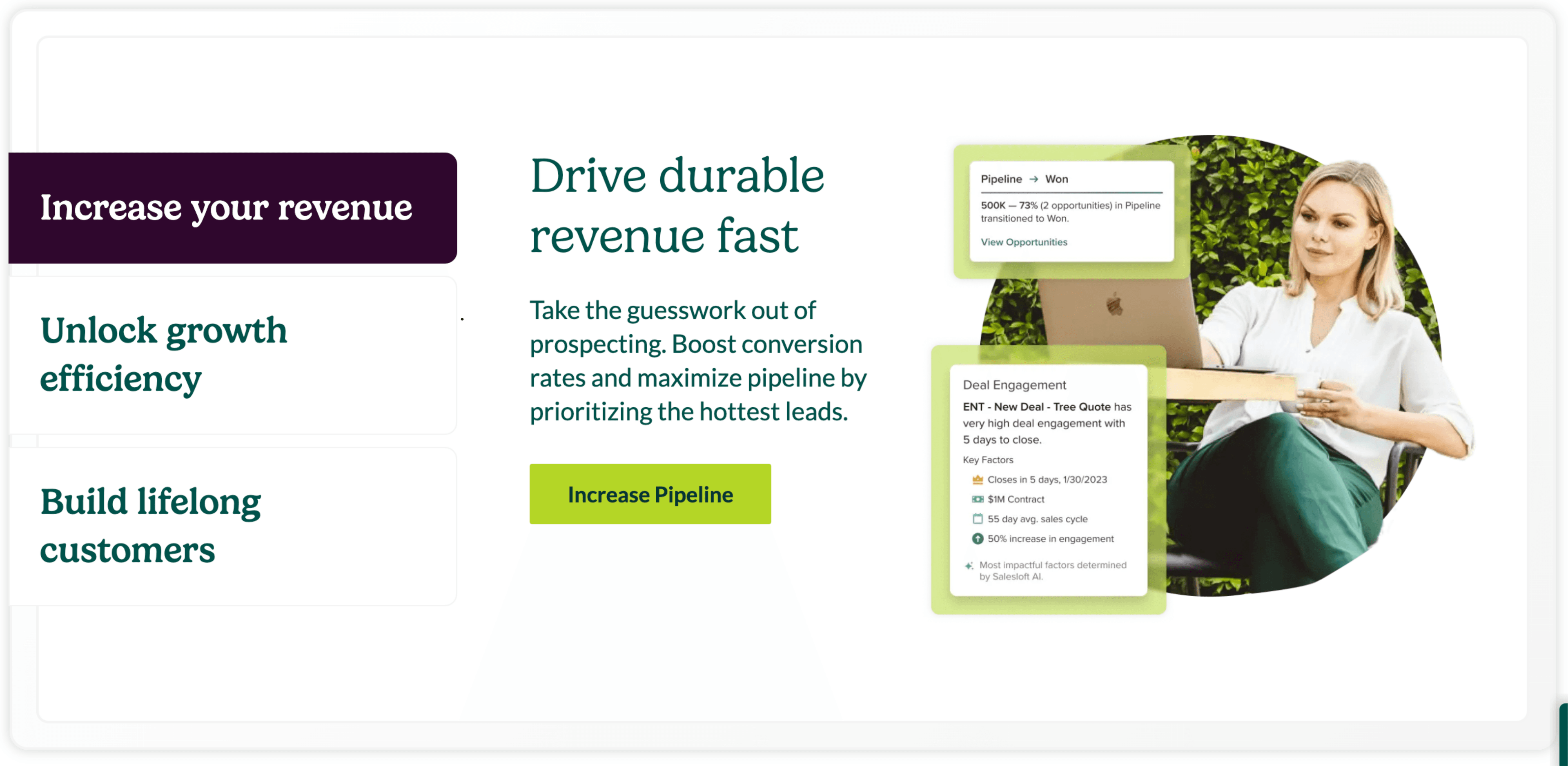
Key Takeaway: Utilize social proof when describing your solution areas to highlight outcomes with more credibility.
The "Our Customers" Page
Before we even get into the nuances of what Gong.io does well on this page, the first observation is that the customers page is structured similarly to a SaaS blog page. Much like how blogs and posts are designed with scalability in mind, Gong.io takes an identical approach with customer stories because getting testimonials is a never-ending process.
Your company will continue to solve new challenges, and brands will evolve. When you think about blogs, a particular post may be generating a large percentage of your organic traffic at a particular time as a search term is trending, but just cause that phase may come and go doesn't mean that you should archive that blog.
Especially in the enterprise space, one additional opportunity can make a sales rep's year. Customer stories are similar because specific stories may drive most upper-funnel metrics at different periods.
However, at any moment, a particular story of a customer might be the asset that resonates the most with an exciting prospect. The right customer story can make them feel like you've had success with customers similar to them before and multiply trust.
Oftentimes, these are case studies sent by a BDR or a Sales rep or something presented to an executive in a later-stage demo that generates the stamp of approval you're looking for. Gong.io understands this.
I mean, c'mon! Their technology centers on finding the conversations that resonate the most with sales prospects!
So, let's piggyback off their millions of dollars of R&D and 4000 customers to conclude that customer testimonials are essential.
Key Takeaway: You can never have too many customer case studies. If anything, you should always be replenishing with newer testimonials to stay relevant with your current offering and recognizable brands.
Featured Area
It's safe to assume that the case studies listed in the feature area are the top-performing pages once a visitor clicks on them.
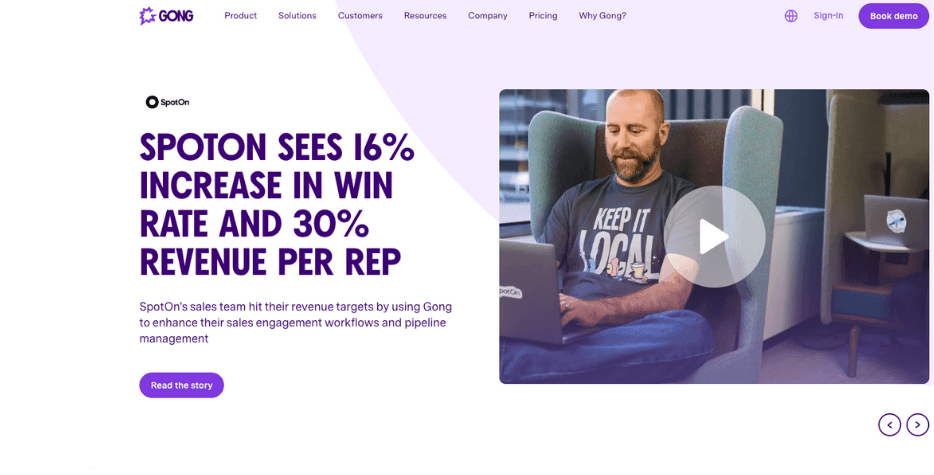
These are likely measured by:
- Time on page
- Demo Requests
In addition, not all case studies are made equal. Sometimes, customers aren't as presentable on camera or less prepared with statistics, so a feature area is great for highlighting the case studies that are most dense with valuable insight.
In particular, Gong has a couple of highly produced in-person video testimonials to accompany the featured case studies. The art of a great video testimonial is a whole other blog post in itself, but at a high level, what Gong is clearly leveraging here is the fact that more than 50% of consumers prefer video content when discovering a product or service(Source:Hubspot).
This number will continue to increase as social platforms like TikTok rise in popularity and a younger generation makes its way into the corporate workforce.
Customer Success Catalog
As you scroll further down, Gong.io does yet another thing very well to ensure that visitors have an experience that promotes credibility and, in this case, trust.
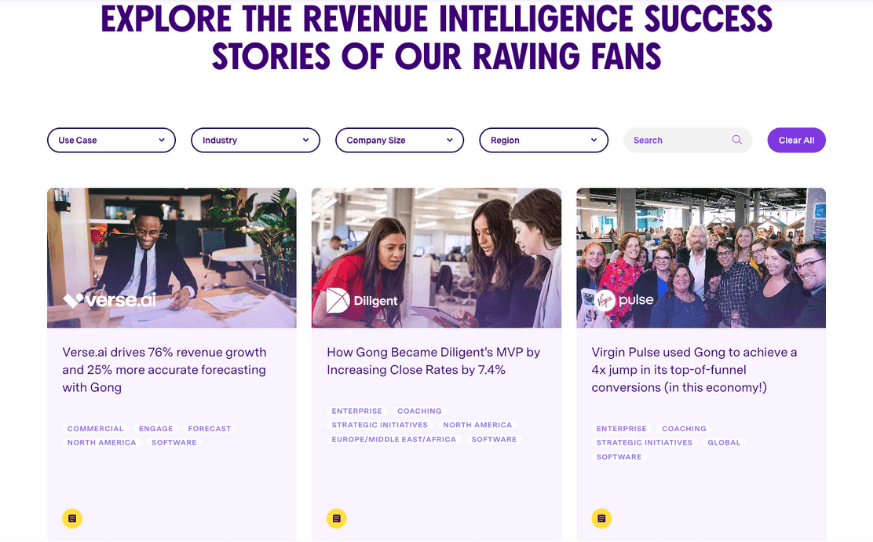
A mistake that many growing companies make is showcasing their best and largest customers to any prospect who will listen. The reality is that your largest customer, who makes up the most significant percentage of ARR, may not be the customer story that can generate the most revenue.
If your product generally serves the mid-market best, then you may be deterring serious prospects because they presume your product might be too complicated or too expensive or assume that they can't expect the same level of customer support.
This is very important to consider when you're using social proof in your sales process, but Gong.io accounts for it even on its customer stories page, and it's quite intuitive.
There are four filters Gong.io serves up to the user.
- Use Case - What problems is your solution solving
- Industry - What types of companies have the most success with your solution
- Company Size - At what scale is your solution most effective
- Region - What areas can you effectively service your solution
If you're a sales or marketing leader, these filters are very familiar because they are the primary characteristics of an ICP (ideal Customer profile) and a TAM (Total Addressable Market).
In GTM strategy, defining an ICP is an honest reflection of what you are good at and who you best serve. From the customer perspective, the more you can explain this to them, the more trust they develop in your ability to deliver their desired outcomes and be a reliable long-term partner.
Your customer stories should be prioritized in the same way.
Key Takeaway: Though it can be less advanced than Gong's navigation bar, clearly lay out in your customer story section the different ICPs you service so that prospects can quickly identify customers that remind them of themselves.
The Customer Story Page
Ok, so you've now clicked into a specific customer story. Whether it was worked into a feature area section from the home page or via the customer's page, the headline that grabbed your attention was "Pitchbook increases Sales by 10x."
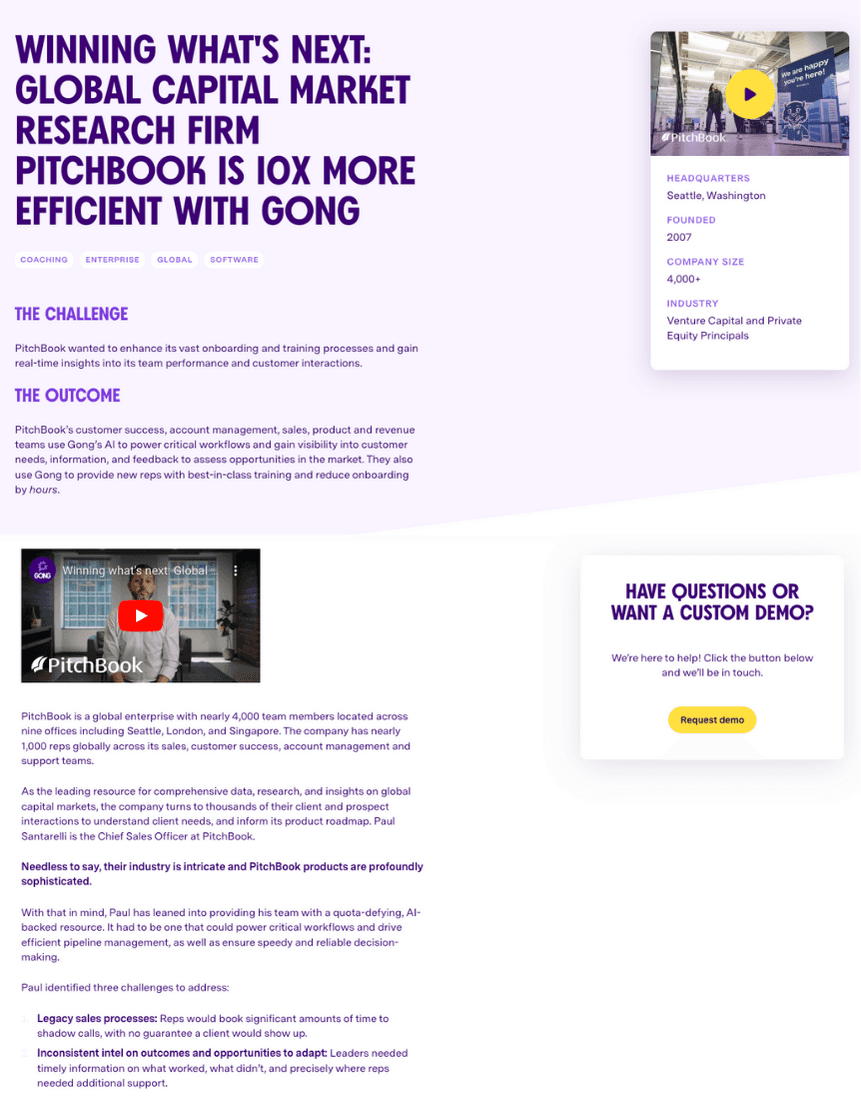
When you land on the customer success page, there's another variation of the same headline, a quick glance of the company's details, and a summary of the customer's "challenges" and the "outcomes."
Highlighting the challenge first is deeply rooted in the sales principle that prospects respond stronger to a reminder of their existing pain points than to the glorious state in which they can prosper in the future. Therefore, it's not surprising that Gong.io elected to lead off with the challenge statement.
The statement is simple, and if the user finds that it doesn't resonate, they've only lost a couple of seconds and might even be willing to click back to the previous page to find another customer story.
Let's go back to the goal of this micro-moment. Side note: the "book demo" icon in the top right corner has followed the visitor across the site the entire time, so let's not include that CTA for this specific micro-moment.
The goal is to either have the user scroll down if the first frame resonated with them OR have them go back to the previous page if it didn't.
Statistically, any user who elects to scroll down is likely aware that the level of commitment to review the case study fully will be a couple of minutes. At this stage, a visitor is multiple clicks deep into your website, showing interest in an outcome you specialize in achieving and reviewing a case study of a customer representing your ICP.
Talk about a hot prospect! Unsurprisingly, after you scroll down from the first frame, you're now presented with a "book a demo" CTA that follows you down the rest of the page as you scroll.
There's something else Gong.io does here that is very thoughtful and, once again, quite simple. Once you scroll down, you're presented with two options: a long-form video testimonial (about 3:30 minutes) and a written case study.
This is effective because you're giving the user options to obtain the information they want in a preferred format.
The written case study extends what was presented in the first frame. The first paragraph summarizes what the customer does.
The second section highlights life before Gong.io. As suggested, they decided to leverage three bullets surrounding their primary challenges.
The third section of the case study surrounds the "solution," but once again, the solution is presented as "The outcome." We're potentially three clicks now from the same headline we saw on the homepage surrounding the feature area.
Still, here we are in the customer story, with a secondary headline in the solution section stating the same thing. It shows how much emphasis Gong.io puts into this narrative across the buyer experience.
Now, let's go back to the primary goal of this micro-moment: to get the prospect to schedule a demo.
Now, it's pretty incredible when you really dive into how the case study has been written.
- "With help from Gong's AI, everyone saves time."
- Using Gong's Trackers, managers are able to uncover coachable moments in mere minutes.
- Managers can find one quickly and bring it into their training programs, 1:1s, and team meetings, or share it immediately with one person or the whole team using Call Snippets
What Gong.io does effectively well is detail how Gong's solutions have addressed specific challenges and what the positive impacts were as a result. But more importantly, they hold back information regarding exactly HOW it solves the challenge.
Instead, it uses naming conventions for certain feature areas of the Gong suite, like "Call Snippets" and "Trackers." Features that undoubtedly are better presented in a demo.
This sparks buyer curiosity and dissuades them from trying to conduct an evaluation all on their own(if that's your goal). They could search across the site for these specific terms to find out more information, or they could just click on the button conveniently located to the right to schedule a demo.
Because Gong is highly modern with its sales technology stack, it has a Clearbit form that needs an email to capture the lead. It's a beautiful thing.
Key Takeaway: Give the user options for how to digest your customer story to increase the likeliness they review the entire story. Entice visitors with challenges and outcomes but hold back on detailing the full solution so they have a reason to see a demo.
In Conclusion
We must remember that Gong.io is a multi-billion dollar company specializing in GTM strategy. So yes, many others will not have the internal resources or expertise that they have when it comes to content marketing, but that doesn't mean we can't analyze specific tactics and emulate them for our own.
When it comes to customer stories, yes, it takes discipline and a conscious effort to capture as many as you can, but in today's post-covid economy, buyers aren't as privy to the production value of a video testimonial, and the fact of the matter is, a thirty-minute conversation with a happy customer can create a bundle of helpful collateral that can enhance various areas of your website, let alone your buyer journey. That capture-once, reuse-everywhere motion is what our done-for-you case study and video testimonial services are built around.
In fact, when it comes to prioritizing where to allocate resources across your content marketing strategy, assets like customer stories often have the highest rate of return. You can learn more about all the content one customer interview can create here.
So what are you waiting for? Think about the micro moments across your website and where you can start mapping social proof-today.
And if you're evaluating where to host an always-on hub for that social proof, our 2026 customer community platform comparison scores the leading options.
And as buyers increasingly start that research inside AI assistants like ChatGPT and Perplexity, whether your proof actually gets cited in those answers is becoming its own discipline — our 2026 generative engine optimization software report scores the leading AI visibility tools.
