
Sales Enablement for ICP
Defining your ICP(Ideal Customer Profile) is paramount when it comes to having impactful sales enablement for your SaaS GTM team.
Ultimately, sales enablement is the ongoing process of equipping your business's sales team with the resources they need to close more deals. These resources may include content, tools, knowledge, and information to help them effectively sell your product or service to customers.
Sales enablement assets can be internal and external—either customer-facing tools that assist the sales team or internal resources to help them better communicate your solution's value to potential customers.
Companies with a well-structured sales enablement strategy experience an average of 84% quota attainment. Additionally, organizations with effective sales coaching programs see a boost of up to 29% in win rates, which shows the significant impact of well-prepared sales teams.
What is the Voice of the Customer?
Defining your "Ideal Customer Profile" and "Ideal Customer Use Case" is more than just understanding who to target, it's about setting a knowledge foundation for your team that promotes customer voice throughout every marketing and sales touchpoint.
This is often referred to as the Voice of the Customer. For teams operationalizing VoC, we compared the top platforms in the 2026 Voice of the Customer Software report.
"Voice of the Customer" refers to how customers perceive and feel about your products, focusing on their expectations, experiences, and overall satisfaction.
Intertwining the Voice of Your ICP
As your company scales and produces more sales enablement materials, it's advantageous to weave the voice of the customer throughout much, if not all, of your enablement content.
By embedding customer perspectives, you can ensure your messaging is consistent across all channels—whether in marketing or sales documentation.
This requires a strategic process to maintain coherence in your messaging, ensuring customer insights remain at the forefront of your sales training and materials.
Interviewing your SaaS ICP Customers
There are typically two types of customer interviews:
- Customer Research Interviews: These interviews focus on product and market research. Product and marketing teams may use them to gather feedback for the roadmap and messaging.
- Customer Testimonial Interviews: These are polished, edited interviews that highlight your solution favorably for marketing purposes.
From a sales enablement perspective, both interview types offer valuable insights into better positioning your product and speaking your prospects' language.
However, the goals of a "customer research" interview often differ from those of a sales leader, and product managers may not want to share their client interview time with sales for this reason.
For this reason, at my first startup, we often coupled our sales enablement research with our customer testimonial process.
Questions to Ask Your ICP
You can simply add 10-15 minutes to the end of a customer testimonial session to ask non-external-facing questions such as:
- What do you care most about in your position?
- What KPIs concern you on a daily, weekly, or monthly basis?
- How do you get a promotion? What do you need to excel at?
- What is the structure of your team? Who do you report to?
- What resources do you use to improve in your role?
- What advice would you give someone considering investing in a new system for X?
- What did you notice was different between us and competitor X?
These answers don't need to be external facing, so you can ask freely and get honest feedback.
As a best practice, transcribe these interviews and use the insights to create valuable resources.
ICP & Persona Cards
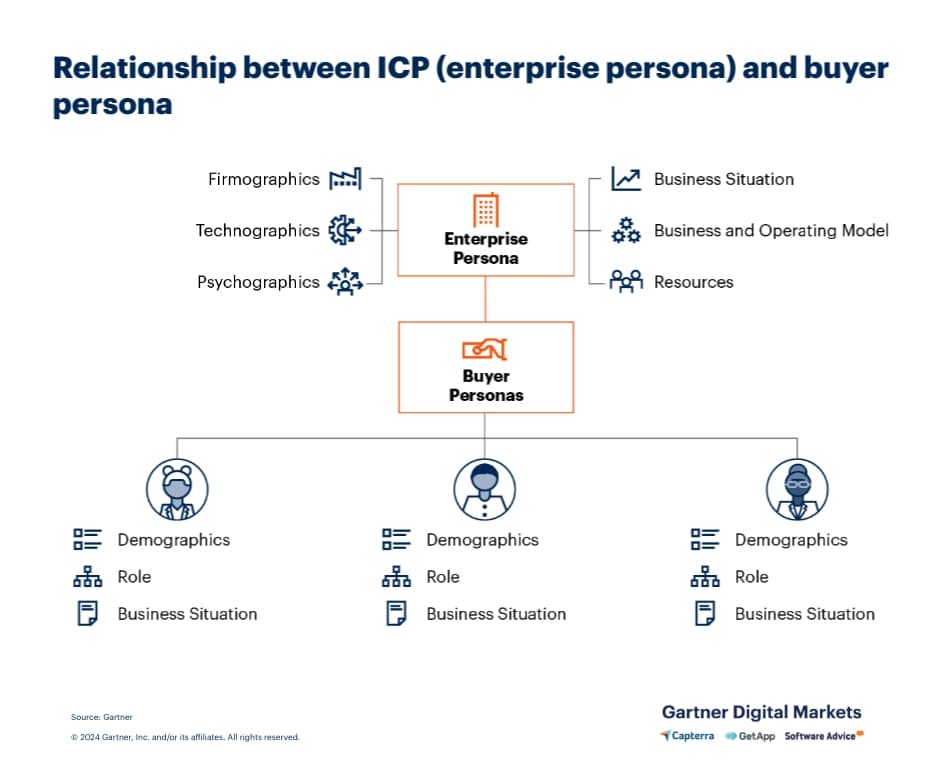
Use these customer insights to create effective ICP and Persona cards. This should be step one if you don't already have a documented Ideal Customer Profile (ICP) and Persona assets for your sales and marketing teams.
Customer interviews are a fantastic way to fine-tune these assets. While you might make assumptions about what's on these cards, the voice of the customer gives you concrete details.
You can even link these interviews to your persona cards so new reps can learn directly from video interviews. Data shows that viewers retain 95% of what they see in a video, compared to just 10% when reading text.
SaaS Customer Win Stories
Sales-win stories help your team learn from successful deals. Unlike customer case studies, which are external, win stories are for internal use only.
They dive into the specifics of how a deal was closed—who the reps talked to, how long it took, what challenges came up, and how they beat the competition.
The sooner you capture these stories, the better, as they can help train new reps and reinforce strategies. Win stories are most powerful when they include both the sales perspective and the customer's point of view.
Raw Interviews
Even if you provide your sales reps with raw, unedited customer interviews, they'll learn a lot.
For example, if you're selling to a specific industry, there might be particular communication methods or key terminology. I once sold in the aerospace industry, and it was crucial to know acronyms and use the term "heritage" instead of "experience."
Raw interviews let your reps pick up these nuances before engaging with live prospects.
You can summarize transcriptions, but in the early stages, watching raw footage is a great way for new reps to understand customers.
This matters as sales reps with access to relevant and timely content achieve a 32% higher quota attainment.
Editing these videos and supplementing them with documentation is beneficial, as this makes interview review more efficient for new reps and ensures that any customer statements that conflict with your desired messaging don't confuse your team.
Sales Roundup (Sales Kickoff)
All of this content is excellent for a sales kickoff (SKOs). Reviewing personas together helps personify your target customers, and reviewing win stories with the reps who closed the deals adds valuable insight.
However, the most valuable training I've used to leverage customer feedback for sales enablement is a live interview and Q&A session with an ICP persona for the entire sales team.
Interestingly, the customers I contacted for these sessions had already provided testimonials. As we discuss here, customers who do one favor for you are more likely to do another.
Imagine hosting a webinar with your target stakeholder but with your sales team as the audience.
I would spend the first half-hour in a podcast-style interview, asking questions such as:
- What do you care about most in your role?
- What does your average day look like?
- How is AI impacting your role?
- What is the hardest part of your job right now?
For the second half, let the rest of the sales team have at it with their questions.
The variety of questions—from BDRs asking about thought-provoking messaging to account reps probing about competitors—added incredible value to everyone present.
In Conclusion
Tapping into your customers' insights is a game-changer for boosting your sales enablement.
By weaving the voice of the customer into your training materials, you're giving your team the tools to resonate with prospects truly.
Whether through persona cards, win stories, or live Q&A sessions, bringing your customers into the mix makes your sales approach feel more natural and relatable.
At the end of the day, mixing proven sales tactics with authentic customer feedback helps your team tell a better story—and that's how you win more deals.
To put customer references to work in live deals, see our 2026 customer reference software comparison.
